Shawls for spring

From left: Worth the Fuss shawl, Fuss Free Festival shawl, KISS shawl.

After what seems like the longest winter ever, I am thrilled to see that here in the UK it does finally seem as though Spring has arrived. We actually have some warm sunshine today which is so very welcome after what feels like weeks of mist, fog and grey gloom. Of course, as is always the way, it's also the day that the kids go back to school after the Easter break - c'est la vie.

I don't know about you but spring always makes me think of shawls. They make for such great layering and transition pieces. With our ever changeable weather here in the UK it can be a guessing game trying to decide what to wear each day and a scarf or light shawl can provide a perfect layer of additional warmth and then then be tucked into your bag as the day warms up. Providing warmth without the commitment (and potential heat exhaustion prospects ) of a full on knitted sweater.

I'm always amazed when I hear of knitters who have never knitted or shawl or who "don't get them". There still remains a perception that shawls are for "old ladies" and for many people the word shawl conjures up images of a large, woollen triangular affair, possibly with a fringe. Wrapped around the shoulders of dear, sweet, grey-haired old lady.

In fact, one glance at the work of Stephen West for example should be enough to dispel this myth forever. Bright, colourful, and exuberant. His designs are the antithesis of the traditional image and like anything in knitting are infinitely adaptable to fit your own wardrobe and aesthetic. So for the next few weeks I'm going to be celebrating my love of shawls in all their wondrous variety. I'm going to be looking at shawl shapes, different construction methods and also some all important styling tips on how to wear your beautiful creations.

If you have a shawl related question or something you have always struggled with please do let me know. Just leave a comment below or pop over to the Facebook Group join in the discussion there.

And just to celebrate the arrival of my favourite (if fickle) season, I've set up a discount code in my Ravelry store. Just use code SPRING for 25% off the price of 3 of my most popular shawl designs: Worth the Fuss, Fuss Free Festival Shawl and the KISS shawl.

In the meantime I couldn't leave you without a message from the man himself. If you haven't seen this before please make sure you aren't watching on public transport in case of accidental guffaws. He is priceless and his attitude to shawl wearing is something I think we can all aspire to.

The items my knitting bag can't live without

If you are anything like me, the bottom of your knitting bag is a sort of graveyard of previous projects with discarded ball bands and snack wrappers. But there are a few constants that I always have about my knitterly person and I firmly believe that you should too.

HIYA HIYA SNIPS - known affectionately as "Puppy Snips" in our household. These are a firm favourite of mine and I have acquired several pairs now. I love that fact that you can attach them to your bag zipper using the handy little chain and the fact that the tiny blade makes them perfectly airline friendly.

WASTE YARN - you never know when you might need to pop in a lifeline or slide your stitches on to waste yarn. I once had a needle break on me in mid-train journey and being able to safely catch the stitches on a length of waste yarn saved much swearing and cursing later on. I really like to carry a small package of dental floss for this - not only is the thread suitably thin and smooth for most yarn types but the integral cutting blade can also be persuaded to cut yarn and can replace your scissors in a travel emergency.

STITCH MARKERS - Although I can make do with loops of waste yarns I always have a few spare stitch markers knocking about. I like to have a few of the lockable markers too - the ones you can clip and unclip. These are really handy for catching up an errant dropped stitch or for marking the right side of your work.

PENCIL and PAPER - As a designer I'm supposed to say at this point that I always have a pretty notepad and pen to hand to jot down design notes or to keep track of a pattern. Sometimes I do, but more often I seem to end up with a random till receipt and a biro. Not exactly as pretty from an Instagram point of view but definitely an essential.

TIN OF HAND CREAM - I always have dry hands and have amassed quite a collection of solid lotion bars, or ones in tins. I tend to avoid anything in tubes after a rather unpleasant leakage episode.

So, those are my must have items - do let me know what your essentials are. I'd love to know.

PIN FOR LATER

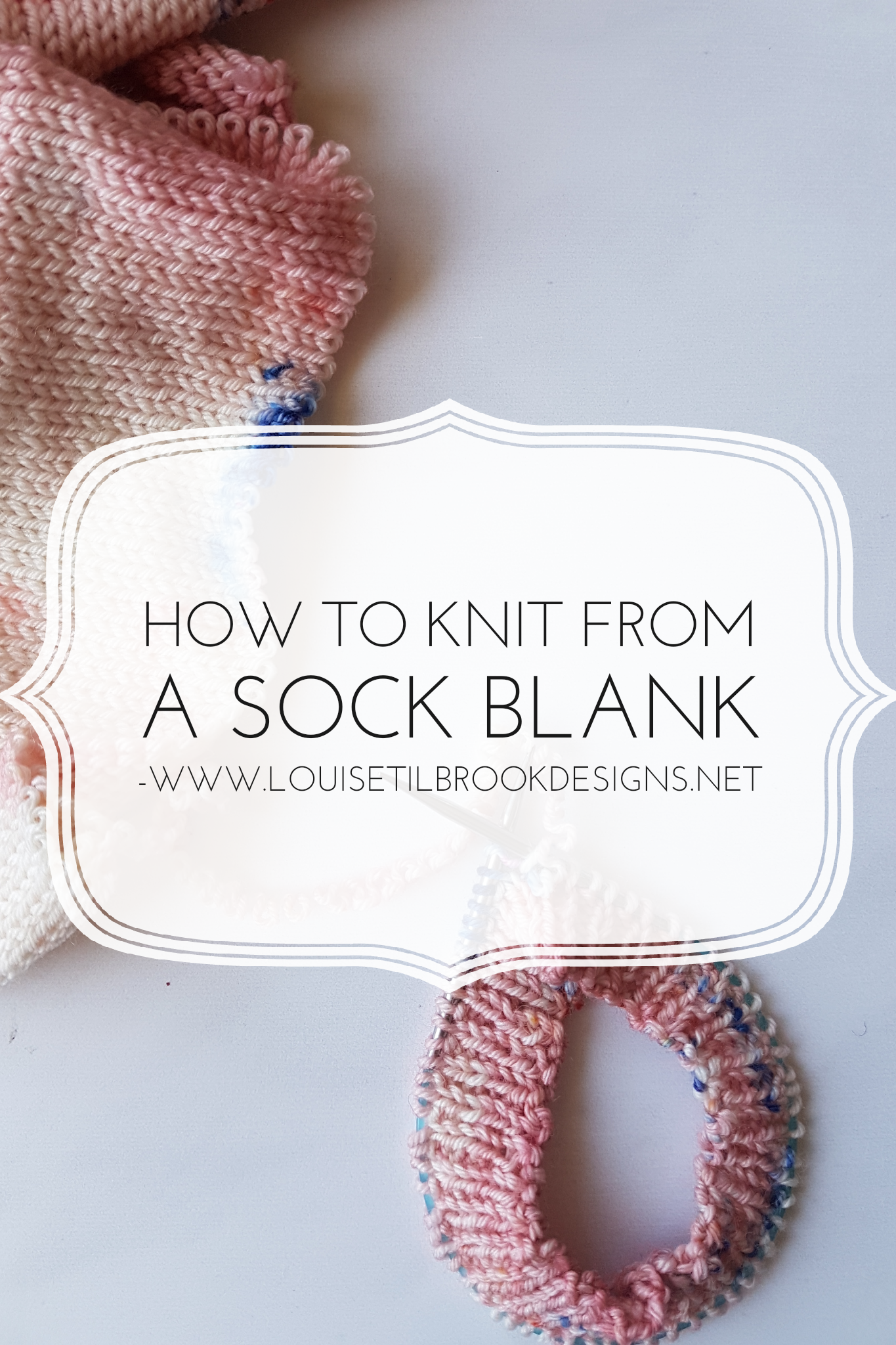
How to knit from a sock blank

What on earth is a sock blank I hear you ask? Simply put, it is a machine knitted flat piece of fabric which you then unravel and knit with. It really is that straightforward. Rather than knitting from a ball or skein or yarn you unravel the yarn as you go and knit with it.

This always baffles my husband. "So you are taking a piece of knitting, and turning it back into knitting?" was his puzzled query when I showed him what I was doing. "Why on earth would you do that?". But he has been around knitters long enough to know not to argue and to accept that we are ingenious souls who come up with all manner of intriguing solutions.

By applying the dye to a flat piece of knitted fabric rather than the actual strands of yarn themselves, dyers can produce a fabulous range of colours and effects that would be very hard to achieve otherwise. A gradient-dyed yarn is much more straightforward to produce from dyeing a sock blank than it is to apply a gradient to a continuous 400m length of yarn, for example. Hand dyers can really go to town and have fun with the dye pots and then, as knitters, we get the inestimable joy of knitting with it, straight from the fabric. There is no winding or caking needed. 

The first thing to is to unroll the fat sausage-like sock blank and check if it is a double layer of fabric or a single layer. If it is a double layer it means that you can knit two socks at the same time (should you want to - don't worry - it isn't compulsory). If it is a single layer you will need to knit one sock at a time. Please don't try to unravel from both ends of a single layer - that way madness lies. The sock blank has a right end to pull the yarn from and a wrong end - it will quickly become apparent when you give an experimental tug and unravel a metre or two.

If you do have a double stranded sock blank and you want to knit with just one strand at once you will need to come up with a solution for dealing with the other strand as you work. Either wind each strand off separately into 2 balls before you start or wind the other yarn around a bobbin (or similar) as you work. If you aren't sure, check with the dyer before buying to make sure you get a sock blank that will work for the project you have in mind.

And that's really all there is to it. Unravel the yarn for a metre or so and cast on. The yarn will have the characteristic "kinky" appearance that you get from unravelled yarn and to be honest it can take a bit of getting used to, but the fun you will have from watching the colours play before your eyes will more than make up for it.

Do I need to reskein and soak the yarn to remove the kinks?

This is a matter of personal preference. For me, I'm quite happy to knit as it is but if you know that this would drive you mad then by all means then you can wind the yarn into a skein, soak, dry and then rewind. The only time that I have done this with a sock blank is when I was knitting from a beautiful single layer of rainbow gradient yarn for my Fuss Free Festival Shawl. Because I was knitting at quite a loose gauge (on 4mm needles) the kinkiness gave an unevenness to the garter stitch fabric that I didn't really care for and it didn't fully go away after blocking. Normally when you are knitting socks, the much tighter gauge used tends to eliminate this problem and any slight unevenness in the fabric is normally undetectable after the socks have been washed and worn.

Have I tempted you? If you do decide to go ahead and try a sock blank do let me know.

PIN FOR LATER

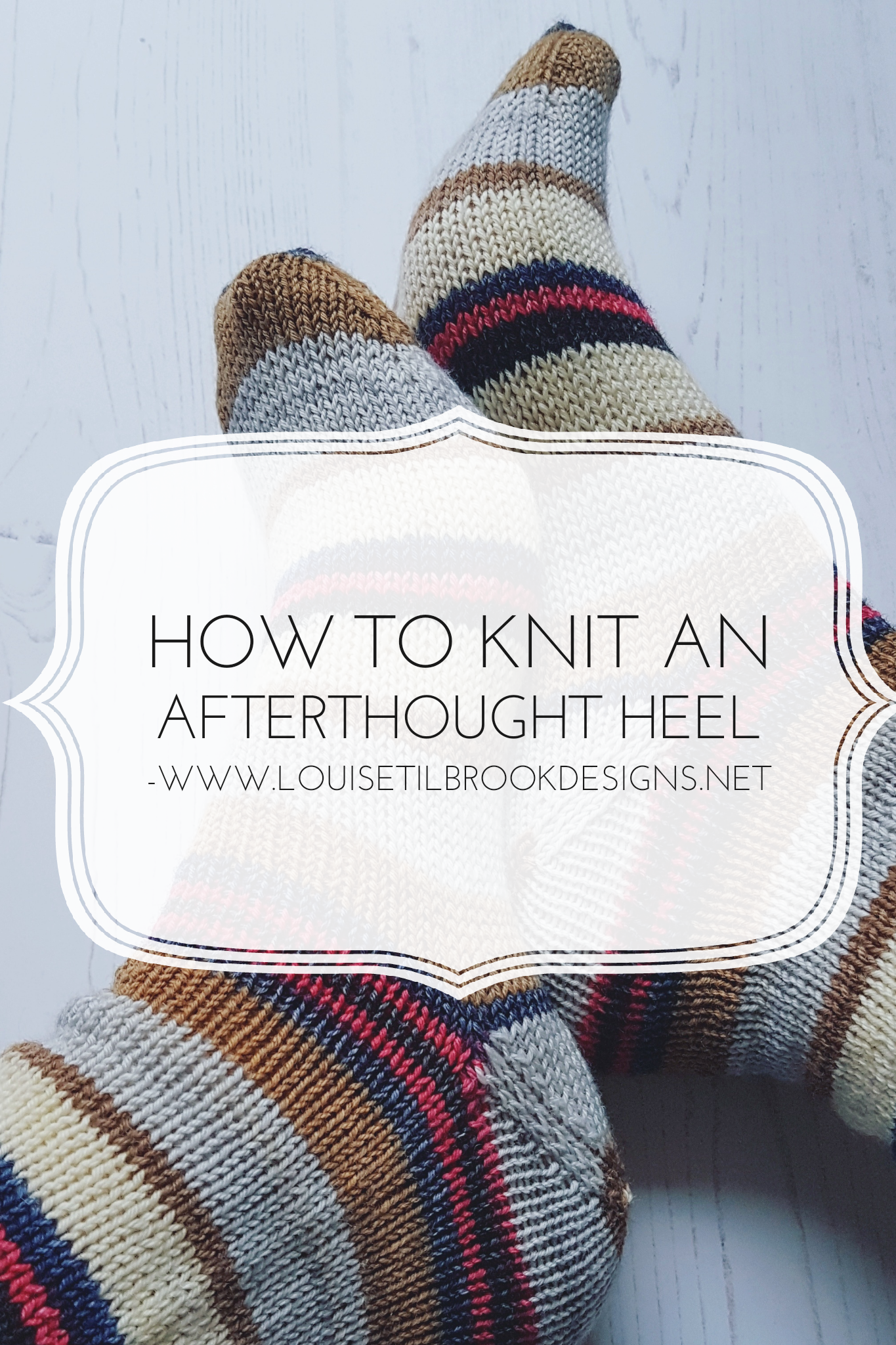
How to knit an afterthought heel

If you follow me on social media you will more than likely know that I'm a huge fan of the afterthought heel and indeed it is one of my favourite classes to teach. Every time I post an image on the subject though it generates a lot of comment and interest and so I thought I would do my best to summarise how I go about inserting a true afterthought heel.

There are also methods which involve knitting in a strand of waste yarn at the point where the heel is to go. This can then be removed from the sock tube and the live stitches placed onto your needles. Confusingly this may also be referred to as an afterthought heel when in fact it is really a Forethought heel - you need to know in advance where your heel is going to go. As you are merrily knitting your sock tube it isn't always possible to stop and try it on or otherwise determine where to place the heel - think crowded train carriage or dark cinema. For these and other reasons I vastly prefer the true afterthought heel.

For this you will need:

  • Your completed sock tube. I prefer to knit both socks and put in the heels at the same time.

  • 3 DPNs - I prefer wooden DPNs with sharp tips

  • 1 lockable stitch marker

  • 1 tapestry needle

  • Sharp scissors

  • Tape measure

1. Work out where to put the heel

Try the sock on and pull it firmly up the leg. Find your ankle bone on the inside of your foot and trace an imaginary line with your finger down to the sole (underside of your foot). Mark this point with a removable stitch marker. It is normally about 2-2.5" from the back of your heel.

2. Start to pick up stitches

Take the sock off, lay it flat being sure to have the toe flat - your heel needs to align with the toe - and starting at one side of the sock start to insert a DPN tip into the first leg of each stitch from the row you have marked with your stitch marker (self striping yarn can be helpful here as, often you can follow the line of a colour change).

Work your way across, take your time being sure to pick up the leg of each stitch until you have half the number of stitches of your total sock circumference. eg. for a 64st sock I would pick up 32st. I find that wooden DPNs are easier to use as they are more flexible but this is personal preference.

Once you have 1 line of stitches picked up repeat the process on the 2nd row below your first DPN. You will end up with stitches on 2 DPNs separated by 1 row of knitted stitches.

3. Identify where to start snipping

Insert a tapestry needle into the leg of one stitch in the middle of that row and pull it up firmly to make a loop. Take a deep breath and snip that loop. Now breathe out and slowly start to unpick the loose thread you have created on each side of the fabric.

4. Start to snip!

Keep going all the way across until you have 2 DPNs each with 32 (or your chosen number) stitches on them and two curly strands of yarn at either end. These ends can be woven in later. I normally tie them in a knot with the working yarn to keep the tension even. I then untie them and darn them in at the end.

5. With all stitches present and correct

It happens to the best of us. During the picking up of stitches if you find that you have missed a stitch and you have one loose, just secure it with a lockable stitch marker and slip it back on the needle as you knit that row.

Use your locking stitch markers to capture any strays

Now, just reattach your working yarn and start decreasing as you would for a toe. Essentially you are knitting a 2nd toe in the middle of your sock. My preferred way of doing this is:

Rnd 1: ssk (sl 1 knitwise, sl 1 purlwise, k those 2 tog tbl), k to last 3 st, k2tog, k1. Repeat on 2nd DPN

Rnd 2: k

You may come across the odd stitch which is aligned back to front on the needle, if that happens simple knit it through the back loop to correct it.

Repeat Rnds 1 and 2 until you have decreased the total number of stitches by half. For my 64st sock this would be 2 DPNs each holding 16st. Try on the sock at this point and check the fit. If you need to do a few more rounds you can continue 1 or 2 more decrease rounds.

Finally - thread a tapestry needle and graft the heel closed, exactly as you would do a toe.

Weave in all the ends and do a happy dance in your new socks! Take a photograph to show me (tag it with #louisetilbrookdesigns)  - I'd love to see your finished heels :)


Important email changes

This isn't a very exciting topic I fear, but in light of upcoming changes to the rules around email subscriptions it is a necessary one. You may have already heard about something called GDPR which is the new EU data privacy law.

It regulates how personal data of EU citizens can be collected and used by businesses, and speaking from a consumer point of view it is a fabulous and long overdue piece of legislation. As a business though it does present certain challenges in order to ensure that we stay compliant with the new rules.

Fortunately I use Mailchimp to hold all of my subscriber information and they have been fantastically proactive in putting efficient systems in plcae behind the scenes. What I will be doing though is making doubly sure that everyone who has signed up to my mailing list is still happy to be there.

My email list is a year or two old now and things change, people move on and folks who signed up a while ago may no longer be interested, and that's totally fine. We all love a good digital declutter from time to time and I am no exception.

Later on this week I'll send out a really important email asking to you to hit reply and confirm whether you would like to stay on my mailing list. Please note that this requires a positive confirmation - under the new law businesses can't assume consent, or take no response as a sign of consent. 

If you want to stay subscribed - and I hope you do - please hit the reply button. If not, you don't need to do a thing, your email address will be automatically removed and permanently deleted from the system.

Apologies for the lack of knitting in this post - I promise to resume normal service with my next post - but I just wanted to make you aware so that you can be on email alert.


Yarn with a mind of its own

Yarn is Manos del Uruguay, Allegria. Colouway Orchid.

After wrangling a new sock yarn purchase for most of the afternoon and battling pooling in it's various guises my yarn and I sat down to have a full and frank exchange of views.

After a glass of wine we decided that actually it didn't want to be socks, that it had never wanted to be socks and that I was cruel and heartless for trying to persuade it into a nice, simple plain vanilla sock.

So, I took the yarn's advice and cast on for a nice garter stitch Fuss Free Festival Shawl instead.

And now everyone is happy.

The moral of the story is clear - sometimes you just have to let the yarn win. And also - a glass of wine helps most (but not all) knitting dramas.