knitting

How to Knit a Sock Snake

This blog post was originally published in 2019. I have revamped it and edited slightly to take into account a few questions I received on it. If you would like a condensed version of this tutorial along with all of my handy hints and tips to knitting the perfect sock snake I have made them available as a short pattern download. The PDF is also available on Ravelry

Buy PDF

Now, you know me - I love a bit of knitting efficiency and I like to knit socks in those spare in-between moments of travel and general hanging around. A recent long train journey meant that I got a bit carried away with the toe-up socks I was knitting. I normally knit around a 16” tube if I’m going to be adding a cuff and an afterthought heel but on this occasion I was engrossed in my Kindle, sipping my coffee and knitting away.

It was only when I got to my destination that I realised that I had in fact knitted close to 22” - practically the foot of sock number 2.

I was absolutely not going to rip out 6” of perfectly good sock so I decided to make a virtue out of a necessity and carry on to make a long sock snake. I had seen someone else on Instagram do this a while ago and the idea had stuck with me since then.

Step 1: knit your snake.

For toe-up socks (8-9” foot circumference, 4ply yarn and 2.25mm needles) I cast on 24 sts using Judy’s magic cast on - 12 on each needle - and work a standard sock toe with increases on alternate rows (to 64 sts). Then knit, and knit...and knit some more. I knit until the tube measured 31” from the cast on and then added a second toe at the other end.

Step 2: divide your snake in half and decide where you are going to snip.

I like to fold the sock flat and pick the midway point - mark it with a pin. Then unfold it and lay it flat in front of you. Using a tapestry needle and waste yarn, slide 1 full round of stitches onto the waste yarn. Repeat with a second length of yarn - leaving one round between each lifeline
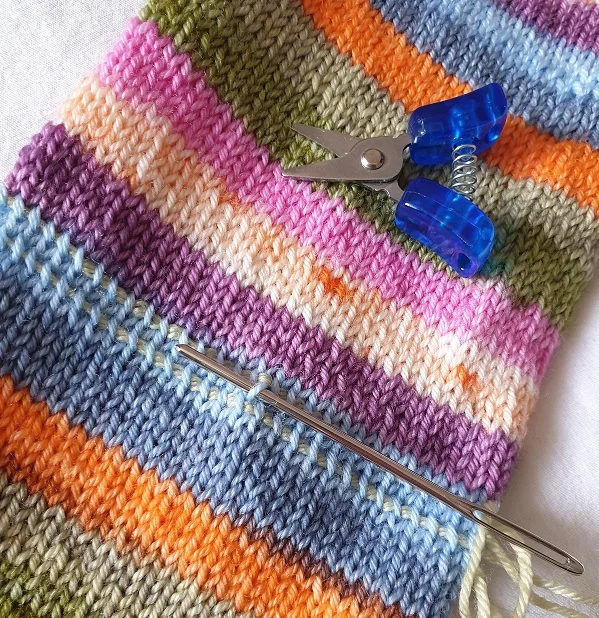
Step 3: Snip (it sounds less scary than cut)

Once your stitches are secure on your two lifelines they can’t go anywhere. Using sharp scissors - snip a stitch in between the two lines and gently unravel the yarn - I like to use the tip of the tapestry needle. Continue around the whole sock until your sock snake becomes 2 shorter snakes.

Step 4: Add cuffs

Return the live stitches to needles, join in your chosen yarn and add cuffs to the two tubes

Step 5: Add afterthought heels

Using the same lifeline process - just across 32 stitches though - add in afterthought heels.

And hey presto - 2 separate socks.


PIN FOR LATER

How to say no nicely

Something of a theme for me recently is saying no. And to get better at saying it without succumbing to a massive guilt attack.

I wrote last week about how I was using No-vember to practice my No muscles and I thought I would continue the theme this week as we head into the Christmas knitting season.

Now, this applies at any time of year of course but especially now, the average knitter often sees a ramping up in requests for “Oh, could you just knit me this”. Such requests often come at a time when you are snowed under with things you are knitting to a deadline or frankly, you just have a lot on your plate and are knitting to retain some element of sanity in the busiest of seasons.

Non knitters frequently underestimate the time and resources needed to make a finished piece. They mean well (usually) but they can catch you unawares so it’s helpful to have a few tried and tested phrases up your sleeve, should you find yourself ambushed by a surprise request.

  • Oh heck, I think my needles might go on strike if I add any more projects to the mix.

  • I’d love to but I have projects on my needles older than my first born.

  • Well, if I start now it might be ready for 2030.

  • I really like to keep my knitting just for personal projects right now as I find it helps me to reduce stress.

  • I’d rather keep knitting as a downtime thing than turn it into a job - but thanks for asking.

  • I’m sorry but I don’t have the capacity for that right now.

  • I like to knit to relax - if I started taking on commissions I’d need to find another hobby to relax from knitting.

  • Honestly I just knit to relax - if I had deadlines it would lose all the fun.

It’s easy to forget that we have the capacity and the power to say no, especially when in saying yes to someone else - we are saying no to ourselves.

What’s your favourite way to say no?

Why summer is the perfect time to start a blanket

Hear me out - I know that traditionally the summer months (here in the northern hemisphere) are generally warm and not conducive to heavier knits. But have you ever thought that actually the summer is the perfect time to start a knitted blanket project.

You have plenty of time to plan and peruse your colour scheme. And then, when you start work on it, it’s pretty small and lap-sized at first. Then, when the colder months roll around it is getting to be the perfect size to snuggle underneath while you work on it - you already have a head start on your cosy winter knitting project.

Clever eh?

I remember thinking this back in 2020 when I knit my enormous Temperature Blanket. I was working a corner to corner rectangle so for the first few months (Jan-Mar) it was tiny and the rows super short. It was only once I got to the full width (Apr-Sep) that I realised that all of the full width rows would have to be done while the weather was at it’s hottest.

Not my smartest move and if I’m honest I fell behind quite a lot. Luckily I was able to catch up and did finish the project by Dec 31st - but next time around I would definitely do it differently.

If you want to plan your very own Temperature Blanket there is no rule that says you have to start in January. You could always start right now - or you could do some forward planning ready for the New Year.

This is where my e-book comes in. This 19 page e-book contains tips, suggestions and resources such as:

  • Working out a temperature scale

  • Yarn choice

  • Estimation of yardage

  • Size and gauge

  • Choosing colours

  • Ideas for construction

It is essentially the guide I wish I had, before I started knitting 😂

Simple ways to make your knitting more sustainable

It is easy to fall into the trap of thinking about the big changes when it comes to sustainability. To focus on the cars we drive, the flights we take (or don’t), the food we eat. But as others have repeatedly said, millions of people taking millions of tiny actions can have a significant impact, even if those changes are really, really tiny.

And our crafting and hobbies are no exception. Yes you can go for the full-on, raise your own sheep and spin your own yarn approach, but for most people that’s simply not realistic. Instead it is far better to focus on tiny changes that you can implement gradually and in doing so have a consistent, cumulative and positive effect on the environment.

A few simple things to think about:

  1. Air miles. Using yarn that hasn’t been shipped halfway around the world is an obvious starting point. Yarn produced in your own country will have less of a carbon impact and if it is produced close to you then so much the better.

  2. Support producers who are actively trying to reduce plastic use and who are committed to reducing their carbon impact. Most reputable sellers will include this information on their websites and if in doubt you can always ask them. Eden Cottage Yarns here in the UK is very forthright for example about the fact they are committed to being as plastic free as possible and all of their goods are shipped in recycleable paper products.

  3. When buying yarn tell the vendor you don’t want or need the additional ‘treats’ that are often included and which often just get thrown away. Sweeties, teabags, pens etc are not required and just add to waste. Do you really need yet another organza bag with your purchase or a tube of sweets?

  4. Use what you have. It seems as though we often forget the simple ‘Reduce, reuse, recycle’ mantra but it’s effective for a reason. Shopping from your stash first before hitting the online cart, or maybe frogging something you never wear and reusing the yarn are both far more environmentally supportive actions than buying new. Also consider a yarn swap party with friends if you feel that your stash needs a freshen up.

  5. Avoiding acrylic yarns is always a slightly contentious one to include, being mindful of everyone’s budgets and constraints. Using natural fibres is a more sustainable choice, in general, but some of the processing required commercially to turn banana fibre into yarn (for example) is extremely intensive and arguably as environmentally damaging as the production of acyrilc fibres especially if the former is shipped from overseas. It is a delicate balancing act and not as simple as ‘avoid acrylic’. It pays to do your research as a consumer and find out exactly where your yarn comes from and how it is made, and not to assume that something labelled natural is automatically better. In addition many yarn brands now are looking at making yarn from recycled fibres and some of these are well worth a look.

There is no denying that it is a complex area and it is tempting to just throw up your hands and do nothing. There are no shortage of people who will jump in to criticise your choices anyway or to point out that you are ‘typing this on your smart phone’.

Anything to do with climate change has a habit of attracting the naysayers who segue seamlessly from ‘our changes are too small to make an impact’ to ‘well, it’s too late to do anything about it anyway’.

It isn’t too late.

Any change however small is helpful.

We can all play a part.

What tiny changes have you made in your knitting? Do let me know in the comments and let’s share our ideas and contributions.

Comfort Blanket KAL 2025

I’m delighted to be able to announce that the Comfort Blanket KAL is back for 2025. Starting in 2019 I have run it as an annual event ever since (apart from 2022 when my father died)

The year doesn't seem complete without my most popular KAL event though so without further ado let me tell you what it's all about.

Tell me more...

The Comfort Blanket KAL 2025 is a 4 week KAL which walks you through every step of planning and getting started on your mitered square blanket journey. I say journey because these blankets - typically knit from leftover yarn are generally considered to be long term projects. No one is expecting you to churn out a blanket in 4 weeks - please don't worry.

Instead the KAL is intended as a springboard to get you started, with ideas and inspiration as well as practical tips for planning and construction.

The KAL will start on Monday 31 March and each Monday for 4 weeks you'll get an email with that week's topic. The information will also be available within a dedicated Facebook group where you will be able to hang out with fellow Comfort Blanket KAL'ers and chat about your various projects.

New for 2025

  • A Discord group for those who prefer a non-Facebook social media experience

  • A daily ‘Coffee Lounge’ thread for general chat about anything and everything

  • Weekly troubleshooting (ask me anything) threads if specific help is needed.

Sign me up

A different kind of social summer

It’s quite common for people to take an Instagram break over the summer, and there are definitely years that I have done just that. Getting back into it in September is always a real barrier though and it can take a while to build up momentum again.

This year I thought I would buck the trend and do something a little bit different - I’m going to go random and post a photo a day - just snippets of my summer. Memories I want to save and things that have made me smile. No pressure, no strategy, no curation or filters. Just happy snaps.

Kind of like how we all posted in 2015/2016 when the biggest decision we had to make was which filter to apply - I was always an F2 girl if you were wondering.

I’ve decided to start with a 30-day challenge to myself and I’ll see how it goes. It might make my Instagram grid look a little weird but does anyone even look at the grid anymore? Probably not.

In terms of writing and more in-depth content then my Substack publication is where it’s at. I’m going to be focusing more on my community there as it’s honestly such a friendly and supportive place to hang on.

Whereas once I would find myself opening Instagram multiple times per day and scrolling stories I now find myself popping into Substack and chatting with people on Notes.

Eyes down for a substack summer: blog post

If you are a Substack reader please do pop over and say hi, and if you aren’t maybe I could tempt you to take a peek. It’s not at all scary I promise and there are tons of fabulous writers (and quite a bit of knitting content too).

You might also enjoy: What can Substack do for you?