Using my Bullet Journal as a Knitter

It’s no secret that I’m a huge lover of notebooks in general and bullet journaling in particular. In my opinion there is no problem so insurmountable that a good detailed list and some highlighters can’t fix.

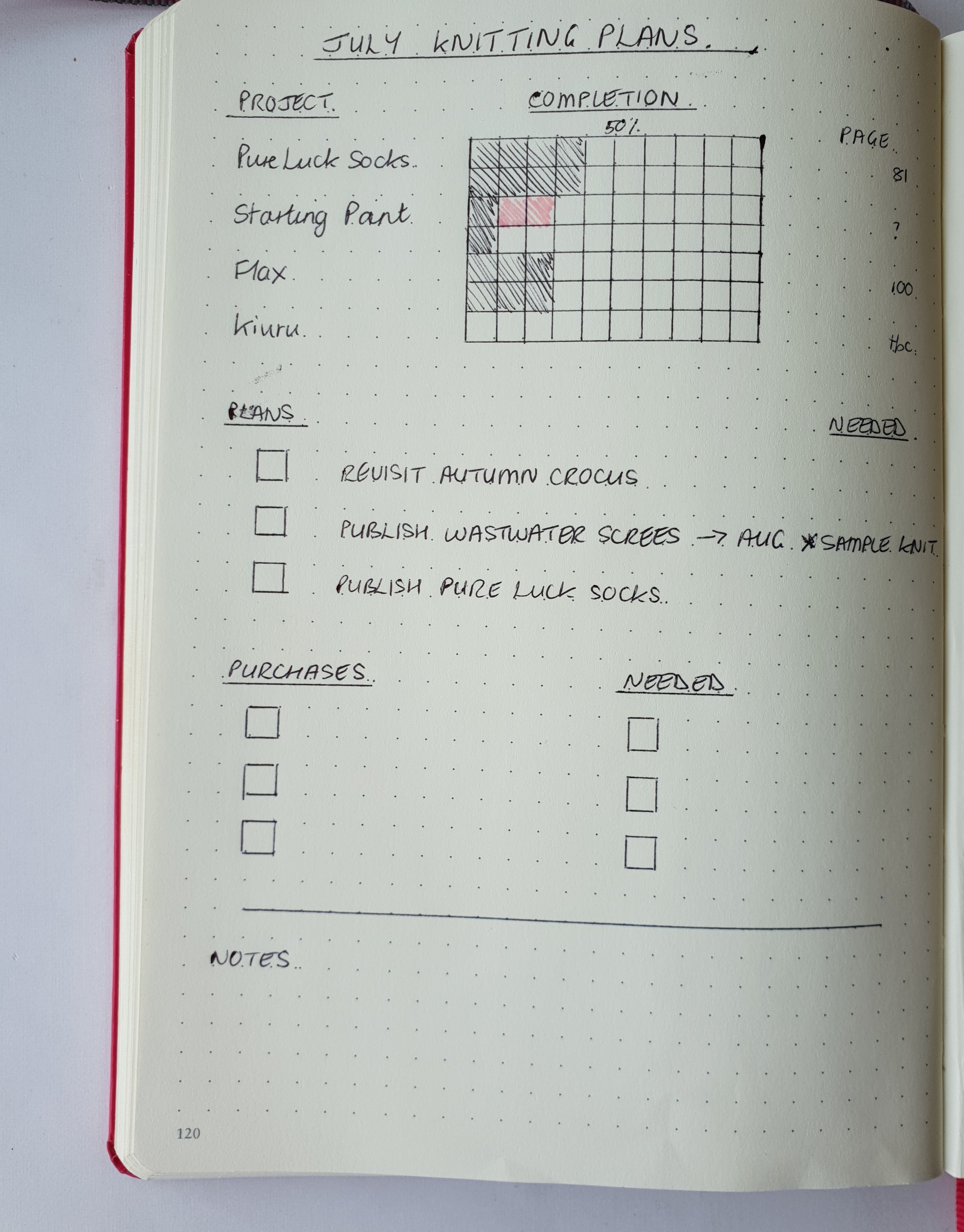
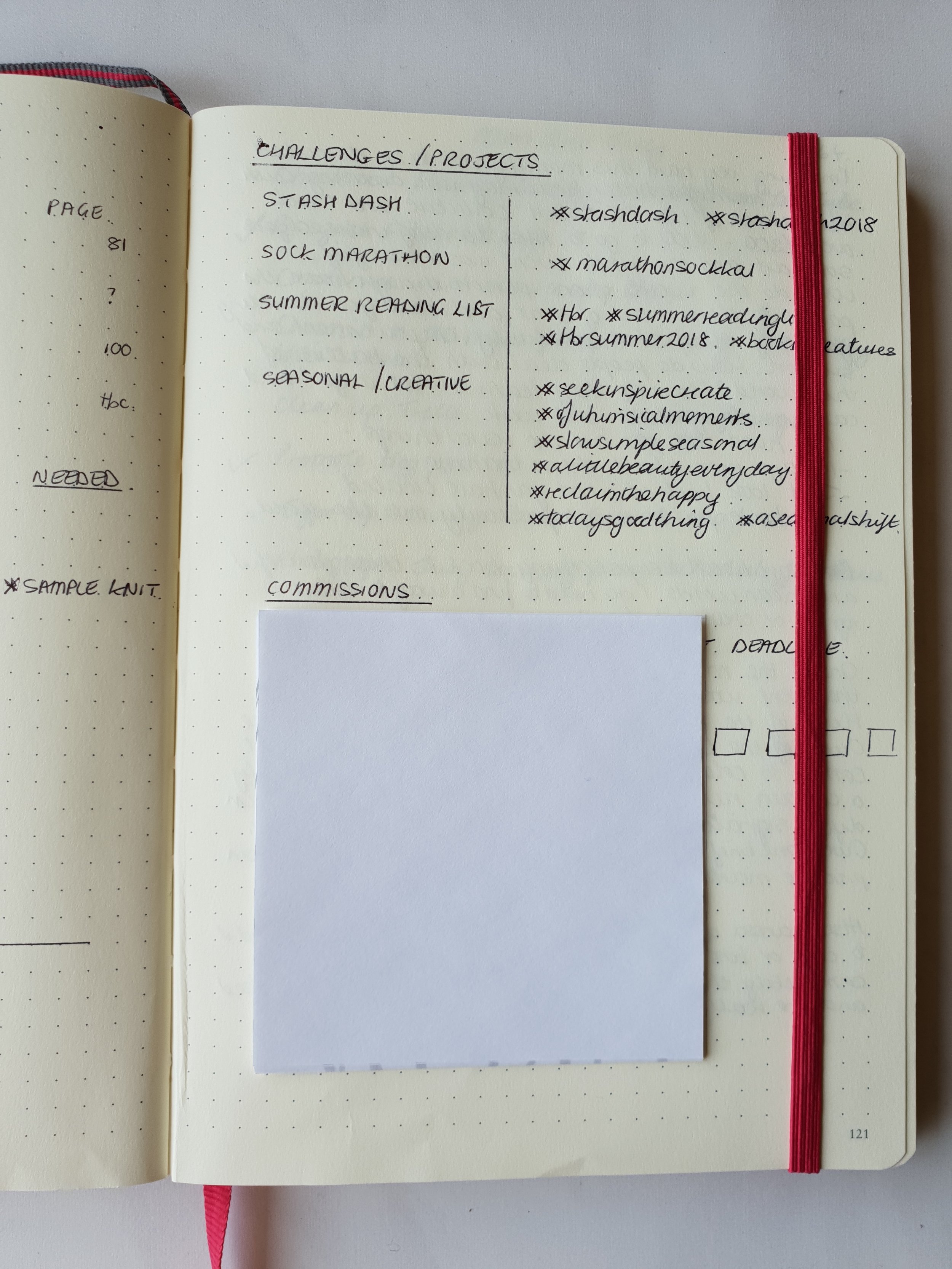
As I know that fellow BuJo fans can never resist a peek into a fellow journaling layout I thought I would share my July planning pages with you and talk a little more in detail about how I combine my twin loves of knitting and bullet journaling.

First of all, if you are new to the idea of bullet journaling you can read more about it at these fabulous resources

Bullet Journaling - by Ryder Carroll

Boho Berry

Tiny Ray of Sunshine

Monthly Spread

My usual bullet journal spread is plain and functional  - no washi tape for me - and at the start of each month I have my calendar/advance planning and then on the double page directly after that I have my monthly knitting plans.

This varies from month to month according to my mood and what I’m working on but at the moment it takes the form of a basic tracker where I list all the projects I want to make progress on this month. I don’t religiously track everything but it helps me to focus on where I want to direct my efforts.

I also keep a note of projects in the pipeline and things that I want to follow up on. And I keep a separate section for monthly challenges or particular hashtags that I want to use or follow. So for July for example - #stashdash is an obvious one that I want to use and engage with.
 

New projects

When I start a new project it gets a fresh double page in my journal and I make a note of it in the index too so I don’t forget. I use this page to keep a note of any pattern adjustments I might make, what needles I'm using and where any particular supplies are kept. Reading this it sounds as though I'm so organised but I think it's fair to say that this section often ends up with a lot of bits of scrap paper jammed in there too.

Other ideas

This is just the basics as I try to keep most of my notes organised electronically these days. But nothing beats the trusty pen and paper especially when you are out and about or your phone battery is flat. I know that other BuJo fans use theirs to keep a track of what they want to buy at yarn festivals for example, or to keep track of their purchasing or stash (scary thought).

But that's the joy of the bullet journal - endlessly adaptable and flexible. It can the knitting planner you've always dreamed of. You just need to use it and make it work for you.

If you don't mind I'd love to see how you use yours - just tag me on Instagram or leave a comment below.


The power of positivity

I've said before that if knitters ruled the world we would have the whole world peace thing sorted out before tea time. And the events of yesterday I think have proved me right - at least in part.

Yesterday I was lucky enough to take part in a collective launch of an online initiative which was the brainchild of the Countess Ablaze. You can read the whole back story here but basically she issued a challenge to indie dyers, designers and other online creatives to come up with a design or yarn based on her iconic colourway "If I Want Exposure I'll Get My Tit's Out". And at 12 noon yesterday over 250 folks did just that - launching their #titsoutcollective products upon the internet.

I was hopping backwards and forwards between Facebook and Instagram and even managed to snag a skein of yarn for myself as well as launching my own design - the Erika Cowl. It was a busy, exciting and uplifting way to spend a Sunday afternoon. Each participant had to choose a charity to donate a proportion of their proceeds to and I can't wait until the end of the month when we all submit our sales totals. The original yarn from the Countess raised over £3000 for a charity and I can't wait to see what our collective efforts will unleash this month.

As with anything online these days there were a number of negative comments too, which was a shame but ultimately did not detract in any way from the huge wave of knitterly positivity that swept through the internet yesterday. People discovered different indie dyers, new dyers sold out of yarn faster than hot cakes and the whole thing was just so inspirational that I was hugely proud to have taken part in it.

If you haven't already done so, please do check out the #titsoutcollective hashtag on Instagram. And if you are a member of the Everyday Knitter Facebook group do keep your eyes out for a cheeky little group project later in the month. It will be a chance to show off your "Tit's Out" purchases in a fun show of support for the Countess and the fabulous project she has pulled off in just 2 weeks.


I never met a grey I didn't like

This blog post could also be subtitled “An ode to grey yarn”.

Anyone who even casually glances at my IG feed or other social media won’t get far without encountering a photo or three of grey yarn in some form or another.

I love colour in so many areas of my life - Leuchtturm notebooks, nail varnish and pens spring to mind but when it comes to yarn choices (for garments especially) I instinctively reach for the grey.

Now you might think that grey yarn is dull and indeed if you are looking at a commercial ball of sock yarn in a shade reminiscent of school skirts then you might be right. But let me introduce you to the wonderful world of hand dyed grey yarn and you might just see things differently.

“Grey skies over Manchester” - dyed by the Countess Ablaze is a work of art and manages to capture exactly all the nuances of the grey, cloudy skies so often seen over my favourite city (seen here in the striped version of my Fuss Free Festival Shawl)

“Baby Elephant” is the wonderfully named grey from The Uncommon Thread which also features heavily in my “perfect grey” list. Seen here in combination with a .

For me, the beauty of grey yarn lies in it’s ability to pair so well with other shades. Nothing makes my heart sing quite so much as seeing a grey shawl or sweater with a pop of bright yellow. Yellow and grey is a fabulous colour combination - just check out the hashtag #grellowlove on Instagram if you don’t believe me. Grey has a miraculous ability to tone down even those most vibrant colours and turn them into something that even the most colour phobic person would happily wear.

So, what do you think. Are you a paid up member of TeamGrey or is it colour all the way?


Instagram likes are your currency - spend them wisely

A great idea came to me late last night, as all the best ideas do. I’d been speaking to my boys about pocket money and the importance of spending it on things that are important to you and then as I was scrolling through Instagram later on I found myself thinking of the system of ‘likes’ and how we use them.

I know we all like to think of Instagram as a non-commercial platform, even though we know that deep down that we are either there to sell or to be sold to. But the sense of community and of belonging in some part at least, overrides this and keeps us going back day after day.

More than anything we crave connections to fellow humans and crafters and Instagram gives us that ability to connect, to chat and to build real meaningful relationships both online and in person.

The way we do that and the way that our social currency works is through the system of ‘likes’. In a way, ‘likes’ are the currency of Instagram and they are what keeps the whole system oiled and moving.

We judge how good a particular photo is based on the number of likes (I know we shouldn’t, but we do). In a way the number of ‘likes’ tells how good/useful/important something is in the same way that we perceive a more expensive lipstick to be somehow better quality than something we paid £2 for.

This is one of the things which has really riled me about the recent wave of spam IG accounts. These automated accounts run by bots are nothing more than machines built to gather likes. They don’t add or create anything but they harvest carefully selected, popular images in order to induce people to hit that ‘like’ button. And of course, people do hit the ‘like’ button - as that’s what made the images popular in the first place. It’s a carefully calculated and manipulated strategy designed to build the ‘worth’ of spam accounts. The more people that they can persuade to ‘hit like’ then the more their account is seen and then ultimately they can sell off that account to a business and make money from it.

As these spam accounts get ever more sophisticated it can be hard to spot them from genuine ones, especially now with the recent trend of using actual people’s names. But reporting and blocking remains the way forward. Ultimately if few people engage with the posts then these accounts will simply be seen less and they will drop further down the grid that Instagram choses to show you.

It’s easy to feel overwhelmed in the face of the relentless proliferation of these accounts but small things really can and do make a difference. Choose where you spend your ‘likes’ wisely and let’s help add value to the real, hardworking crafters of Instagram.

PIN FOR LATER

Stripy socks really do go faster

I’ve been plugging away on a plain vanilla sock - no pattern - for what seems like eons now but which is in actual fact just a few weeks. It’s lovely yarn, a hand dyed sock yarn blank. Dyed to create lovely speckles and splashes of colour as you knit, but if it weren’t for a few strategically placed stitch markers I would feel as though I were making no progress at all.

A recent pair of stripy socks though positively flew off the needles. So much so that I swear house elves have been coming in at night in a scenario reminiscent of the Elves and the Shoemaker fairytale. The magic promise of “just one more colour” combined with a few Netflix watching sessions - DH and I are currently addicted to The Last Kingdom - meant that a few times in the morning I picked up my knitting only to be genuinely surprised at how much I had done the previous night.

I don’t know about the laws of space and time but it seems to me that stripy socks occupy a time dimension all of their very own.

How to spot a fake Instagram account

It’s a strange thing and I don’t pretend to understand the reasons for it but spam IG accounts seem to have become a bit of a thing recently, especially on some of the main knitting hashtags. Many of them appear to be particularly random, reposting content from a variety of accounts either with or without credit.

I am reliably informed by people working within the IT industry that many of these fake accounts are randomly generated - so called “bots” - which automatically skim content from various hashtags and repost them. I guess there is some reassurance in the fact that even though the use of your images may feel deeply personal and shocking, there is no malice or ill wish behind having your images used in this way.

[Please note that here I make a distinction between these bot accounts and the malicious copying/hacking of certain accounts. The latter is fortunately much less frequent but it is targeted and motivated by a desire to harm or someone damage someone's online reputation]

It doesn’t stop these fake accounts being annoying though and if nothing else it does effectively “dilute” the quality content on the hashtags which are affected - by having the same few images be reposted again and again.

One thing I have noticed is that they are increasingly hard to identify at first glance and look like they could be real accounts, especially now they seem to have moved away from the very generic @knitting_insta_loves to much more plausible sounding names which could well be real people.

I often mention in my IG Stories about accounts that I have reported and blocked and people often ask how you can tell. How do you spot a fake IG account?

Although I am by no means an expert I do spend a lot of (read: too much) time on Instagram and I have found that the following things generally set my alarm bells going:

Content is not consistent from frame to frame: Most knitters and crafters show progress on their crafty endeavours or the same types of images/props/items crop up in repeated photos scattered throughout the feed. It’s just human nature. We tend to share what we like and often those images are broadly similar. Spam accounts rarely show the same project twice and may vary widely in content.

Spam accounts harvest images from a variety of accounts often lifting the entire caption too. If an account has posts with text in a variety of languages, or is promoting an Easter discount in June then you can be fairly certain that it isn’t genuine.

Under the caption there is often a generic comment such as “tap to like” “do you agree” “tag a friend” which is out of context with the caption. In some cases there is a credit given to the original account but from experience I can tell you that this doesn’t always notify the original image owner. I’ve had accounts use my images with an apparent credit to @louisetilbrookdesigns but no notification has ever reached me.

Once you start looking for such accounts you’ll probably realised that they are much more ubiquitous than you thought. Often they are the same unfortunate images which crop up time and again.

Happily there is something you can do about it though. If it’s your image which has been reposted without consent you can click on the three dots (top right of the image) and select the option to report for copyright infringement. Top tip: it’s best to do this from a laptop/PC rather than a mobile device. You will be asked to provide links to your original content to prove that the image is yours.

If the fake account hasn’t used your images but you would like to block them and/or report them as spam, you can click on the same three dots to do that too. It might seem as though such actions are a drop in the ocean of a sea of fake accounts but Instagram really does take action and the more accounts we flag up to them as spam the more they can help keep our IG feed spam-free.