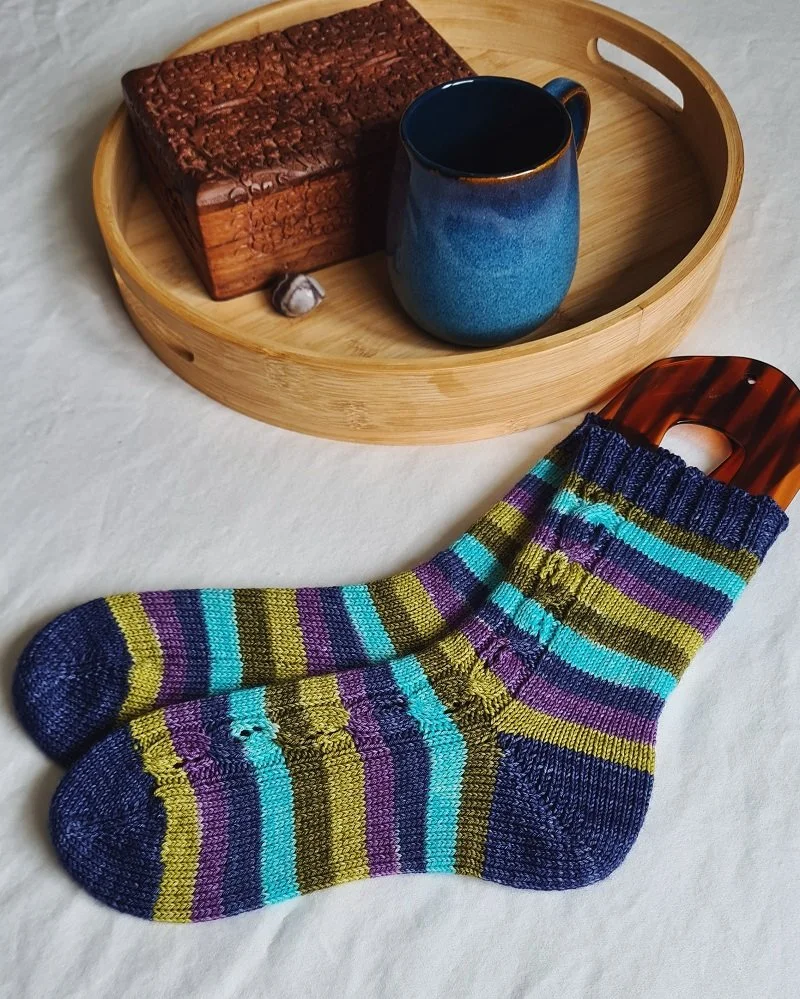
Feel Better Socks
Most sock patterns are written with a preferred method of small circumference knitting in mind - whether that be DPNs, magic loop or a small circular needle. It is of course perfectly possible to knit socks however you chose and we all have our favourite methods.
Experienced sock knitters know how to easily adapt a sock pattern for different types of needles but there are a few tips and tricks that can help you switch methods with ease.
Regardless of how the pattern is written, the key thing to take note of is the stitch count and how those stitches are distributed across your needles. Assuming you are knitting a cuff down sock, most knitting patterns will tell you how many stitches to cast on and how many are needed to knit the leg of the sock - note that in some cases (eg with cables) additional stitches are added after the cuff in order to accomodate the tightness that cables can cause.
Once you have the stitch count - in this case we are going to use 64sts - proceed as follows:
Knitting with 4 DPNs
Divide the stitches across 3 needles 16/16/32 and use the 4th to knit with. The 3rd needle with 32sts is used to hold the stitches for the back of the leg and the heel. The other two needles hold the stitches for the top of the foot. The heel flap and turn is worked across the 3rd needle. The gusset decreases happen at each side of the 3rd needle, bringing the stitch count back to 32sts.
Some prefer to use 5 DPNs with the stitches divided as 16/16/16/16 and knitting with the 5th needle.
Knitting with magic loop
This is by far my preferred method, mainly because it makes things nice and simple. Stiches are divided equally across both needles - 32sts on each. The heel is worked on one needle. I find that this works well for more complicated patterns or cables - especially across the top of the foot - as it means you aren’t dealing with mutliple needles across a 32st chart.
Knitting with a small circumference needle
Perhaps the simplest method, although it does get a bit more complicated for the heel turn. Simply cast on the 64sts, place a marker to denote the beginning of the round and knit away. Perfect for knitting the leg - and indeed the foot. I often find though that it’s easier to transfer the heel stitches to a DPN when it comes to that part, just to make life a little easier. Some people also like to use a second small circular.
Which is your favourite method to knit with?
We all have our favourites, but having another method or two up our sleeves is always handy for when the occasion arises.

