Sock knitting

Five mistakes I made as a new sock knitter

Mistakes are part of life - there is no getting away from that. But when it comes to sock knitting there are a few simple concepts that it is helpful to grasp before you pick up the needles. Why not learn from my mistakes so that you don’t have to:

  1. Not using specific sock yarn. Most sock yarn has a small acrylic component to help with wear and tear - and also to provide much needed stretch. Common blends are 75% wool/25% nylon or 80/20. Yarn with a higher acrylic component may not be as breathable and no one wants cold, clammy feet.

  2. Not realising the importance of gauge. It’s essential to get socks that actually fit and are comfortable to wear. I tried to knit socks in DK yarn on 2.5mm needles and let’s just say they weren’t a success. If armour plated booties were a thing they might have had a role.

  3. Negative Ease. It took me ages to figure out why my socks were always too big and slid off my feet. Well fitting socks need to stretch in order to hug the foot properly. This means that when you are deciding on heel placement or when to do the toe decreases, it helps to stretch the sock fabric quite firmly - not just a polite pull.

  4. Persevering with DPNs because I thought everyone used them - and not realising that other options would suit me better. There are whole host of sock knitting options available to you - from magic loop to small circulars, Flexiflips or two-at-a-time. Don’t be afraid to experiment until you find the method that suits you best.

  5. Offering to knit them for neighbours - never again!

If you take one piece of advice from this article it would be number 5. Trust me on this 😂
How to convert a sock pattern to different needles

Feel Better Socks

Most sock patterns are written with a preferred method of small circumference knitting in mind - whether that be DPNs, magic loop or a small circular needle. It is of course perfectly possible to knit socks however you chose and we all have our favourite methods.

Experienced sock knitters know how to easily adapt a sock pattern for different types of needles but there are a few tips and tricks that can help you switch methods with ease.

Regardless of how the pattern is written, the key thing to take note of is the stitch count and how those stitches are distributed across your needles. Assuming you are knitting a cuff down sock, most knitting patterns will tell you how many stitches to cast on and how many are needed to knit the leg of the sock - note that in some cases (eg with cables) additional stitches are added after the cuff in order to accomodate the tightness that cables can cause.

Once you have the stitch count - in this case we are going to use 64sts - proceed as follows:

Knitting with 4 DPNs

Divide the stitches across 3 needles 16/16/32 and use the 4th to knit with. The 3rd needle with 32sts is used to hold the stitches for the back of the leg and the heel. The other two needles hold the stitches for the top of the foot. The heel flap and turn is worked across the 3rd needle. The gusset decreases happen at each side of the 3rd needle, bringing the stitch count back to 32sts.

Some prefer to use 5 DPNs with the stitches divided as 16/16/16/16 and knitting with the 5th needle.

Knitting with magic loop

This is by far my preferred method, mainly because it makes things nice and simple. Stiches are divided equally across both needles - 32sts on each. The heel is worked on one needle. I find that this works well for more complicated patterns or cables - especially across the top of the foot - as it means you aren’t dealing with mutliple needles across a 32st chart.

Knitting with a small circumference needle

Perhaps the simplest method, although it does get a bit more complicated for the heel turn. Simply cast on the 64sts, place a marker to denote the beginning of the round and knit away. Perfect for knitting the leg - and indeed the foot. I often find though that it’s easier to transfer the heel stitches to a DPN when it comes to that part, just to make life a little easier. Some people also like to use a second small circular.

Which is your favourite method to knit with?

We all have our favourites, but having another method or two up our sleeves is always handy for when the occasion arises.

Have you ever knit a Princess Sole?

The Crow Moon socks featuring a princess sole and a garter stitch, short row heel

Have you ever knit a pair of socks with a princess sole before?

A Princess Sole is where you purl the stitches for the underside of the sock rather than knit them. This means that instead of walking on the side of the fabric that has the ‘purl bumps’ you instead have the smooth stockinette fabric against your foot.

Some people who have sensory issues with handknit socks find that this type of sole suits them much better. For myself, I don’t normally find it to be a problem except occasionally with a yarn that has a very firm, high twist.

Either way, it is a useful trick to have in your sock knitters bag of tricks. Although I feel as though I should give you fair warning and say upfront that it does mean you’ll spend more time purling in the round than you might like.

Purling the sole stitches is a straighforward practice although it does take a little bit of getting used to, especially if you are a longer term knitter used to doing a traditional sole. And if you have delicate tootsies it might well be worth a try.

The Crow Moon socks are designed with a Princess Sole in mind and have a slipped stitch demarcation between the purled sole and the textured upper part.

Being brave

Sometimes you just need to take a deep breath and go for it, whether it's applying for a new job, making that dreaded phone call or tackling your next big project.

If you've followed me for a while you'll know that I'm no stranger to the fine art of procrastination. In fact it's probably fair to say that I could procrastinate for my country if it were ever to become an Olympic event.

For ages now I've been wanting to do a Facebook Live in my group (Everyday Knitter). I've planned it, rehearsed it, imagined it but never actually taken a deep breath and done it. Various excuses have included "I'll just wait until I've had my hair cut" and "I need to find the right shawl to wear".

Yesterday I listened to the very inspiring Making Good podcast with Jen Gale. There was a whole episode about making more out of Facebook and using it to best advantage. Jen is so down to earth and practical that I just thought - "why the heck not".

I was going to wait for the right time (I even scheduled it in my diary) but then I found myself with 10 child free minutes and just took a deep breath and went for it. I was very nervous but people were very kind with their comments and I'll definitely be doing it again. I'd like to do a weekly slot where people can ask questions and each week I'll pick one at random to answer.

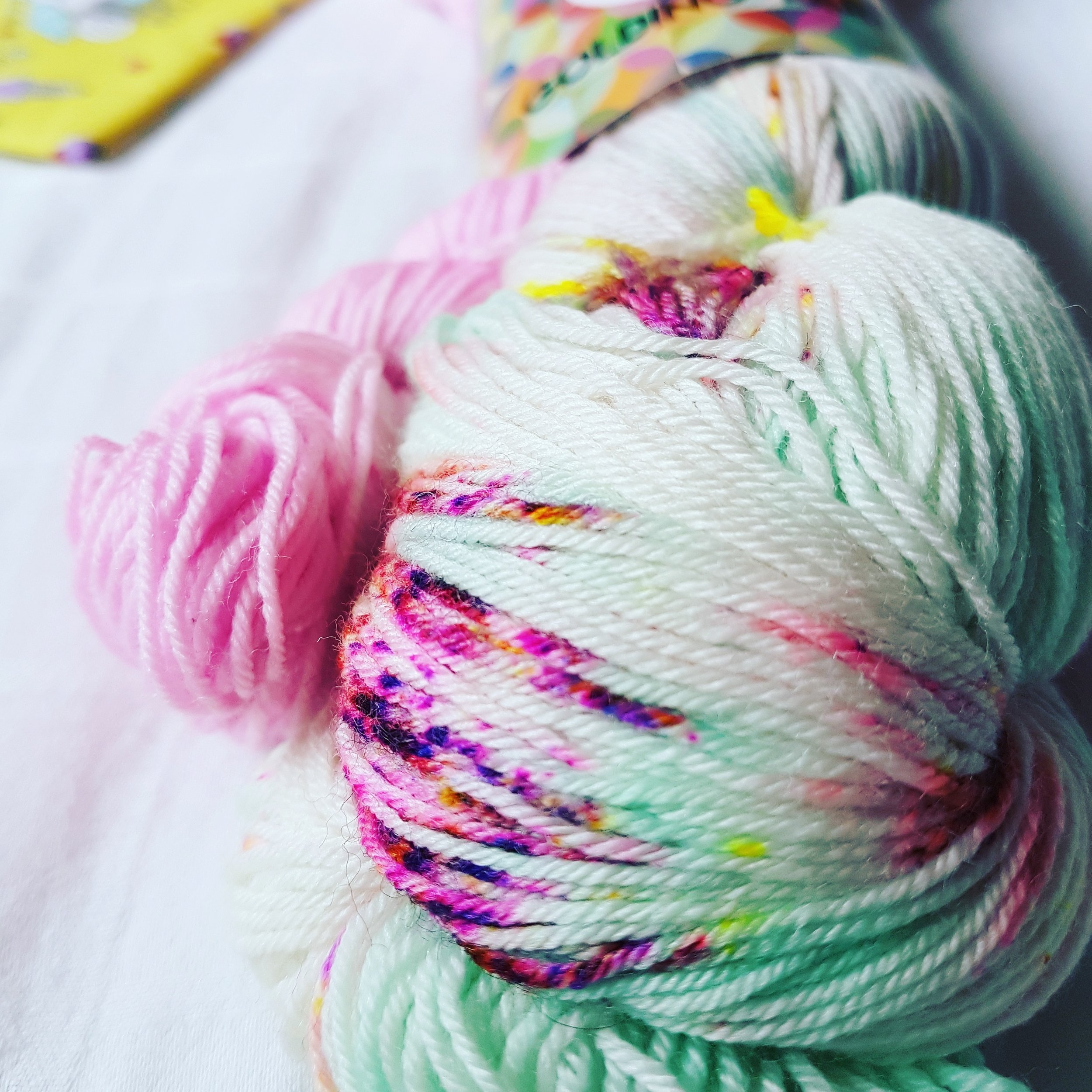
Sometimes you need to take leaps of a smaller scale too. This skein of gorgeous yarn from Goldings Yarns has been sitting patiently in my stash. It came in the Mystery Gems package from The Little Grey Girl a while ago now and I've been saving it for that "perfect project".

But in the interests of "just going for it" and as an antidote to the horrible grey weather we are having at the moment, it's going on my needles today.

Bright, cheery, fearless socks are on the way.


How to work a rounded toe

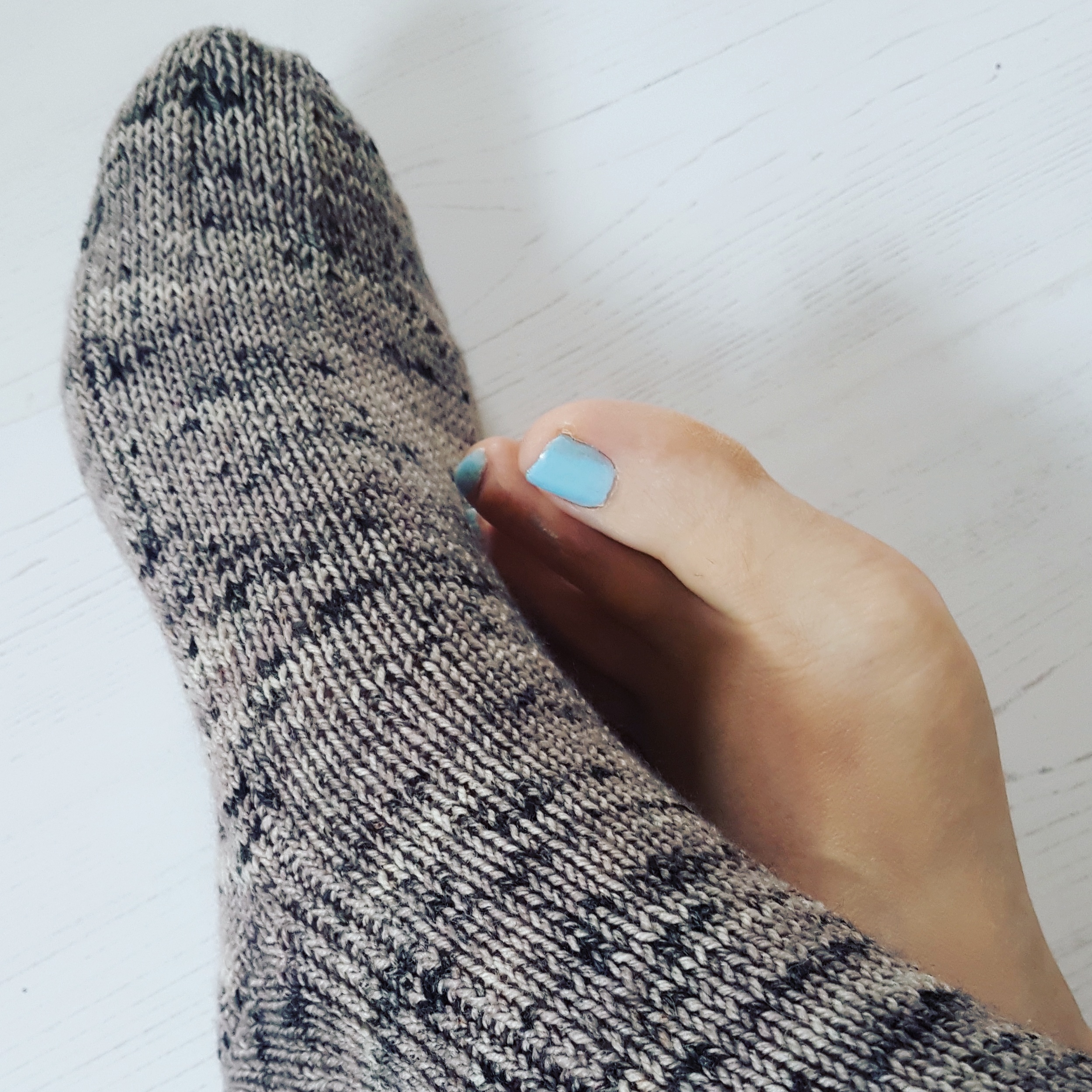
A few people asked about the rounded toe on my latest sock - specifically about the fit. This is the best photo I have to show it but it is really comfortable. A little roomier than a standard toe but so far no complaints at all. And of course, the added advantage is that there is no need for Kitchener stitch. To work the toe was super simple too. On 64st:

K6, k2tog to end

K6 rnds

K5, k2tog to end

K5 rnds

K4, k2tog to end

K4 rnds

K3, k2tog to end

K3 rnds

K2, k2tog to end

K2 rnds

K1, k2tog to end

K1 rnd

K2tog to end

Break yarn and thread back through rem 8st using a tapestry needle. Pull tight and weave in end.


A fickle beastie

Gauge - it's a fickle thing alright. For years, in fact for most of my sock knitting career my default option has been for sock yarn and 2.5mm needles. No messing, no fuss and no thinking required. Now suddenly my default option started giving a sock yarn fabric that was a bit too loose, a bit too wibbly and not at all as smooth as I would like.

I've no idea why, my needles haven't changed, but suddenly it seems as though only 2.25mm needle tips will do. It happened on my last pair of socks and I put it down to the fact that the yarn I was using was quite tightly spun and maybe a bit less plump than some of the yarns I had been using. But nope, it seems to be an issue for all of my socks now.

This delightful yarn from Easy Knits would probably look good at any gauge with those little neon pops of colour but it seems that for me 2.25mm needles are now the perfect sweet spot.

The only problem of course is that I only possess 2 pairs of said needles. I have 2.5mm tips all over the place but now it seems I need to restock.