Knitting life

What to do when you've run out of time for gift knitting

We’ve all been there. Watching the days tick down before the holiday period - acutely conscious that your pile of unfinished WIPs seems to be increasing as the big day approaches. Panic starts to set in as you realise that you have drastically over committed yourself and you start to send up fervent prayers to the Knitting Gods that next year, you promise you’ll start earlier. If only they could just grant you a few more hours of knitting time.

I have to confess that I abandoned the concept of gift knitting a few years ago. It helps that my children are older and no longer expect the elves to bring striped socks on Christmas Eve -also their feet are much bigger than mine. I knit for loved ones throughout the year and if it happens to coincide with a birthday or special event then so much the better. But I don’t place that pressure and weight of expectation on myself anymore. It feels like a way to be kinder to myself at what can be an extremely stressful time of year.

If you are gift knitting though and keeping a firm eye on the diminishing hours, may I present my firmly tongue in cheek suggestions to power through your gift knitting.

  1. Knit faster. Yes, I know it’s blindingly obvious but for me I know that I can speed knit in short bursts if I need to or if a deadline looms. I remove all the distractions, leave my phone in another room and put on a tried and tested box set to watch. Setting myself a goal of solid knitting for 1 or 2 episodes of Schitts Creek for example is an excellent way I’ve found to really get some solid inches in.

  2. Stop cooking. Drastic, yes but desperate times call for desperate measures. More than once I have suggested we have a ‘picky tea’ - which is generally an invitation to raid the fridge/cupboards/leftovers and compile a meal from the harvest. When the kids were small I would put a picnic blanket on the living room and call it an indoor picnic. Either way, it freed up precious knitting time.

  3. Crying and stress eating - not recommended obviously but I’ve definitely done this in extremis. It doesn’t get the knitting done any faster though.

  4. Give an IOU. This is obviously the one I have had most success with and the one that I recommend most heartily to you. Unless the recipients are very small (and their gifts are also correspondingly tiny) I recommend taking the pressure off yourself. All good things come to those who wait, after all. By all means take a photo of what the intended item will be - or gift wrap half a sock if it makes you feel better. Those who are truly knitworthy in your life will appreciate that good knitwear doesn’t just fall off trees. And if they aren’t truly knitworthy then you could save yourself the trouble and just buy them a box of chocs instead.

Whatever you choose to do, may I take this opportunity to wish you and yours a very happy and peaceful Christmas, however you are spending it and to say a sincere thank you for being here with me this year.

Tips for avoiding seasonal overwhelm

Plain toe-up socks in WYS Gingerbread yarn.

I’m sure we all know those super prepared people - the ones who have all their Christmas cards written and presents bought by bonfire night, not to mention all of their knitted gifts done and dusted. If you are reading this though, then I’m sure you’ll be heartened to read that I am not one of those people.

Every year around this time of year I swear that next year will be different and that by 1st December I will be wearing a large, sparkly T shirt that says “I’m ready for Christmas”. And every year the festive season hits me like a tinsel covered tow truck. Every single bloody year.

Over the years I have gradually pared down the list of Christmas essentials, eliminating everything that doesn’t bring me joy or that causes undue stress. For your reading pleasure I present a short list of things I have found I can reduce or do without in hopes that it inspires you to declutter your festivities as well:

  1. No knitting for others, unless I really want (and have time) to

  2. No late-night shopping or activities after 7pm

  3. No Christmas cards except for relatives and people I won’t see in person

  4. No festive baking - unless I am really in the mood and I want the house to smell nice

  5. Stepping away from social media the minute I find myself bookmarking Christmas decor ideas

  6. No Elf on the shelf or Christmas Eve boxes - but we do give Christmas Eve books.

  7. No hot chocolate stations or similar Pinterest-y fad of the year

  8. No present buying for spouse (we each do a donation to Crisis instead)

  9. Every Friday I replace my daily bullet journal to-do list with a ‘have done’ list. It’s easy to focus on everything that you haven’t done but I find when I look back at the week and list all the things that I have accomplished it gives me a really positive boost.

In case you think I’m a complete Grinch I do really enjoy (aspects of) Christmas. I just like to enjoy them on my own terms, in my own way and without putting pressure on myself and others. For this weekend that looks like buying mince pies and eating them under a blanket, whilst knitting on some more Christmas socks.

Creativity Matters

“You can’t use up creativity. The more you use, the more you have”

Maya Angelou

This is one of my favourite quotes on creativity - so much so that I have it written in the front of my journal where I see it every day.

Journaling is a big part of how I connect to my creative side - through words rather than images - which sounds a little strange at first. Often when we think of creativity and art we think in terms of painting, drawing and other visual representations - and with that can come a whole set of baggage (complete with wheels and a carry on bag) about stories we have told ourselves over the years.

That we ‘aren’t good at art’ or that we aren’t ‘the creative type’.

I’ve written about this before - You are creative, even when following a pattern - and it’s something I feel really strongly about. I believe that we all have the capacity to be creative, we just might not recognise it in ourselves.

If this sounds familiar to you, I thought I would put together a couple of the prompts that I use regularly in my journaling practice. I find that they help when I’m feeling a bit stuck or I feel that my brain needs a creative boost. I grab a notebook and pen (coffee helps) and let the words do the talking.

If you’d like to have a try at journaling for creativity, please just tap the link below.

Five fun facts about Herdies

Photo credit: chandler-media-xb_oRYa-TJ0-unsplash.jpg

Try saying that 3 times fast :)

Seriously though, Herdwick sheep are the most amazing of creatures and every time we visit the Lake District I’m always thrilled to see these little smiley faces peeping at me through the bracken. Or - more usually - standing stubbornly in the middle of a single-track road.

Over the years I have amassed a few interesting facts about these most handsome of sheep and I thought, in the spirit of Wovember I would share them with you here:

  1. 95% of all commercially farmed Herdwick stock lives within 14 miles of Coniston and they have an unparalleled homing instinct which means they can be left to roam free on the fells with very little human intervention. It’s known as being ‘heafed’ or ‘hefted’ - the process by which they actually belong to and are part of the landscape itself. Each flock carries knowldge carried down through generations of mothers so that each sheep instinctinely knows how to not only survive, but thrive in what can be a harsh environment. They know where the best shelter is, the best grazing at a given time of year and they pass that knowledge on from mother to daughter.

  2. They are born dark brown (usually with amusingly shaped white eye-goggles) and gradually get lighter over time. A year old Herdwick has a brown body with a light grey head, and over the course of their second year the wool on their bodies also lightens.

  3. Herdwicks are smaller than most commercially farmed sheep and slower growing. They are a dual purpose breed - used for both meat and fleece. In the past their use for fleece fell out of favour but thanks to the efforts of conservationists and sheep enthusiasts the unique properties of Herdwick wool are now being appreciated again - in companies such as this one

  4. Beatrix Potter was passionate about Herdwick sheep and campaigned strongly to ensure the breeds survival in the 1940s. She bequeathed 4,000 acres of land to the National Trust, with the proviso that it be used for Herdwick sheep farming.

  5. They can survive the harshest of winters and there are many reports of them being dug out alive after days trapped in snowdrifts. There are even reports of sheep which have survived such conditions by eating their own fleece whilst waiting for rescue.

In short, they may look cute but they are seriously tough cookies. You never want to mess with a Herdie - and they always get right of way on single-track roads.

How to make a blanket grow faster

Do you ever have one of those projects that just steadfastly refuses to grow? It seems to defy the laws of physics - yarn is being consumed, time is being spent and yet each time you measure it, it remains stubbornly the same.

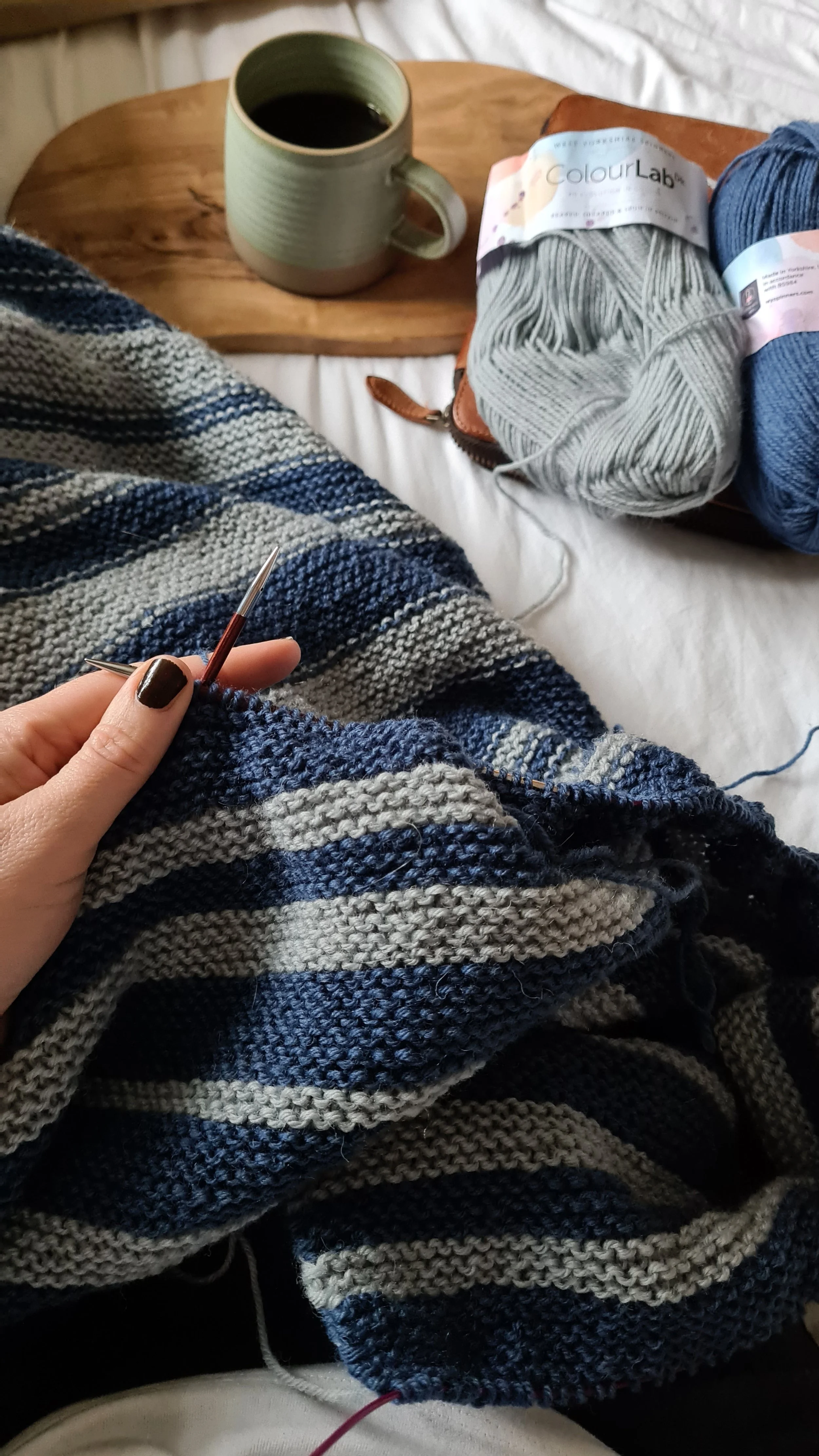
I have a blanket like that on the needles. It’s a stripy garter stitch baby blanket and I’m on a deadline but no matter how much I knit on the thing it still refuses to reach the finish line.

For the purposes of private amusement yesterday I compiled a tongue-in-cheek list of the strategies I had employed so far to make the blanket knit up faster and I thought they might make you smile too.

  1. Keep stopping to stretch it out and measure it. Be sure to stretch it hard for maximum optimism.

  2. Put in progress keepers - lots of them - so that you can see physical evidence of progress.

  3. Use snacks as a reward. My preferred method is a square of chocolate after every pattern repeat or set number of inches.

  4. Persuade yourself that rectangular is the new square - much more practical. You aren't giving up you are just making a design choice.

    Only options 2 and 3 have ever had any measure of success for me. But I'm totally open to other suggestions.

PIN FOR LATER

Things I wished I'd known when I started knitting

I remember vividly standing in John Lewis (a large UK department store) with a birthday voucher and a vague hope of taking up knitting again - after not touching the needles for over 15 years. The choice was overwhelming and I had absolutely no idea where to start in selecting something for my first project. In the end I bought a Rowan pattern book and the specified yarn/needles to make a striped sweater.

Overall, the knitting of it was a success. I remembered how to do the basics and I produced a flat, seamed sweater that was fine in all respects - apart from the matter of the too tight bind off at the neck which meant I couldn’t actually get the thing over my head.

And then I accidentally felted it, but that’s another story altogether.

The point being that if I could go back in time and tell my baby-knitter self a few things, it would be these:

  1. Don’t bother buying a lot of straight needles. Interchangeable circular needles are so much more adaptable to a variety of projects and better for travelling and ergnomics. If you do happen to need a pair of straight needles, you can pick them up in charity shops for pennies.

  2. Buy the good yarn. Enough said.

  3. Don’t buy yarn just because it’s on sale. Especially the large 10x50g packs of DK/aran weight yarn unless you are absolutely certain you are going to use it. They take up a lot of space and sales are generally repeated from time to time. There are always bargains to be had.

  4. Don’t fall into the trap of thinking there is only one way to do things. Whether it’s different cast-offs, cast-on’s, cabling with and without a needle etc, there’s always more than one way to do something and it pays to have a few of them up your sleeve.

  5. If you are a Continental knitter, learn to throw the yarn - and vica versa. As with point no. 4 it’s good to have more than one way of doing something at your disposal and changing things up from time to time can be a good way to avoid repetitive injury.

  6. Gauge matters. It really does. In time you might be able to wing it a little based on experience but in the beginning at least, a gauge swatch is absolutely essential if you want something to turn out how the designer intended.

How about you? Is there anything you would go back and tell yourself when you were a beginner? Do let me know in the comments.